
Investment Commentary – Q2 2026 Liftoff, Leverage and Long-Term Investing

Q2 2026 – Commentary
In mid-June, SpaceX made its public debut on the Nasdaq in a landmark moment for markets. The IPO was the largest on record, raising $85.7 billion at a valuation of nearly $2 trillion and briefly making Elon Musk the world’s first trillionaire. In the days that followed, ETF providers quickly introduced a series of leveraged products, allowing retail investors to gain 2x, or even 3x, exposure to SpaceX. At least six such ETFs are currently available. While it is impossible to forecast the eventual outcome for SpaceX, the stock price has “returned to earth” after peaking at $225 and as we write, the stock is off -49% from its highs, trading close to $115 per share. We have previously raised concerns about the gamification of investing and the gambling-like, “get rich quick” mentality influencing many market participants. Recent developments suggest those trends remain firmly in place.
Speculative behavior is not confined to the U.S. market. A more pronounced example is unfolding in South Korea, where the stock market has been one of the most recent beneficiaries of the AI narrative. Key chipmakers Samsung Electronics and SK Hynix, which together account for nearly half of the index, helped push the market to record highs. South Korea’s roughly 14 million retail investors, known locally as “ants” because they trade in small amounts individually but represent large flows collectively, bought AI-related names heavily and increasingly used margin loans and leveraged single-stock ETFs to magnify returns. As the market retreated from its June peak, many experienced the downside of leverage.
With the market down more than 28%, an estimated 10% of the country’s brokerage accounts received margin calls, and more than 300,000 accounts were forced to liquidate positions to repay margin loans, adding to selling pressure. We view this as a practical example of the risks of leverage and a warning about the current speculative trading culture.
Today, global equity markets continue to rise as investors track the latest developments in AI and assess where future value is likely to emerge. While the rally initially centered on semiconductor chipmakers, it is now broadening into areas such as hyperscalers and banks. At the same time, investors must navigate a constantly shifting set of risks, including unresolved tensions in the Strait of Hormuz, ongoing CUSMA negotiations between Canada, Mexico and the U.S., rapid changes in the AI landscape, and rising government debt. Against this backdrop, the challenge is how to invest responsibly while maintaining discipline and perspective.
We believe the answer is to reject the stock market casino mindset that has become increasingly common. Speculators often chase quick gains through concentrated positions and short time horizons. Our approach is different: maintain a long-term perspective, build diversified portfolios, and focus on compounding and preserving wealth over time.
History supports the value of a long investment horizon. In the U.S. stock market, represented by the S&P 500, the worst three-year period on record was 1929 to 1932, during the Great Depression, when the market declined by roughly 27% per year. That would have been a very difficult outcome for an investor with a short time horizon. Yet over longer periods, the picture changes meaningfully. There has been no 20-year period on record with negative annualized returns. Even the weakest 20-year period generated approximately 2.4% per year, despite including both the Great Depression and World War II. These results highlight the power of patience for investors with the resources and discipline to stay the course.
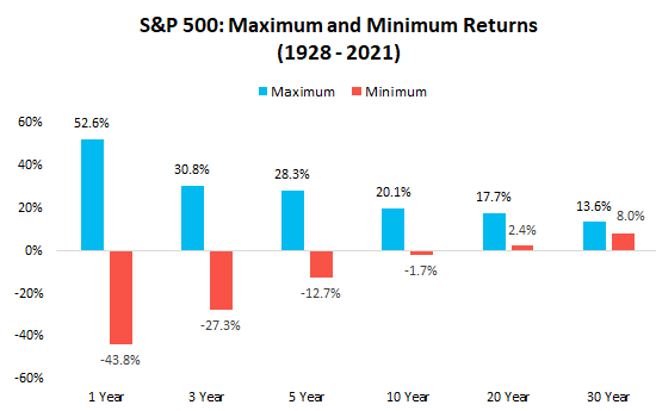
Source: billelo.blog
A long time horizon helps investors look through near-term uncertainty, but it does not remove the need to manage risk through thoughtful portfolio construction in the present. In an environment where market leadership can shift quickly and investor enthusiasm can become detached from fundamentals, portfolio composition matters.
Diversification is the other key part of the equation, often described as “the only free lunch in investing,” a phrase commonly attributed to Nobel Prize-winning economist Harry Markowitz. While traditional stock and bond portfolios may be geographically diversified, we believe they can be strengthened by adding non-traditional asset classes such as private mortgages, absolute return strategies, real estate, private equity and venture capital. These strategies add differentiated sources of return and can help cushion portfolios during periods of public market volatility.
At Our Family Office, we focus on building All-Weather Portfolios suitable for every market environment. The exact composition varies by client family, but the guiding philosophy is consistent: focus on risk together with return and construct diversified, resilient portfolios for the long-term.
Q2 2026 – The Markets
In the second quarter, geopolitics and technology continued to dominate market movements. Risk sentiment turned positive as investors looked ahead to a resolution of the Iran war. With the announcement of a ceasefire, despite a steady stream of back-and-forth statements, oil prices began to trend back toward prewar levels, helping lift stocks for a rally that carried through late May. More recent developments suggest an end to the conflict may be further off than hoped. Among the factors putting the brakes on that rally in June were growing expectations that the Fed would raise interest rates before year-end to combat inflation.
The U.S. stock market, represented by the S&P 500 Index was up 15.20% (in US dollar) for the second quarter. Sector performance was mostly positive for the quarter, with only the energy sector producing a meaningful loss (-12.9%). The best performing sector was technology (+33.2%). From a size perspective, small caps outperformed large caps. Growth stocks outperformed value during the quarter.
While the top stocks in the second quarter of 2026 were still tied to the AI theme, the performance leadership mostly flipped from the Magnificent Seven to so-called “picks and shovels”. Nine of the twelve biggest contributors to S&P 500 gains were semiconductors and memory chip stocks. Hundreds of billions of dollars are expected to be spent on building AI data centres, which are being equipped with advanced chips and other hardware.
At the same time, there is limited supply of chips and memory worldwide, so prices of these and related component parts surged—and so did estimates of future revenues and earnings of these companies.
Canadian markets had a positive quarter with the S&P/TSX Capped Composite Index up 6.96% (in Canadian dollar terms), thanks to strong performance from basic materials and financials, although energy detracted from performance.
International equity markets performed positively during the quarter. The MSCI EAFE Index was up 12.4% (in Canadian dollar terms) for the quarter. Emerging markets were strong with the MSCI Emerging Markets Index up 24.74% (in Canadian dollar terms). Key performance contributors include Korea and Taiwan, driven by strong investor demand for electrical equipment and semiconductor companies, although these same semiconductor stocks retreated in July.
North American trade entered a new phase on July 1st, with U.S. President Donald Trump declining to renew the United States-Mexico-Canada Agreement for another 16 years. As part of a mandatory six-year review of the continental trade pact, the three countries had to decide on July 1st whether to extend the USMCA until 2042. Without a 16-year extension, the agreement moves into a period of annual reviews until 2036. If no extension agreement is reached by 2036, the USMCA will expire.
Most Canadian exports will continue to enter the U.S. tariff-free, while certain sectors, namely steel, aluminum, copper, metal derivative products, automobiles, lumber and furniture will continue to face tariffs of between 25% and 50%.
The Trump administration announced new tariffs on a range of Canadian goods starting from August 19th. Additionally, on the date of this commentary, July 24th, the United States imposed a new global tariff regime on most of its trading partners with levies of at least 10%. These replace the tariffs struck down by the Supreme Court in February, although the stated reasoning is allegedly due to forced labour in the supply chains.
US government bond yields stayed relatively flat in the quarter with the 10-year Treasury yield up 15 basis pointing to 4.47%. U.S. inflation accelerated as the Consumer Price Index (CPI) rose 4.2% in May before cooling slightly to 3.5% for the 12-months ending in June. Most of this gain was due to a sharp jump in gasoline prices. Core inflation (i.e. CPI excluding food and energy costs) rose 2.6% on an annualized basis, which sit above the Fed’s 2% inflation target.
The Federal Open Market Committee (FOMC) met twice during the quarter and left their overnight rate unchanged, targeting a rage of 3.50% to 3.75%. The committee’s current median outlook for the end of 2026 is for a possible, modest rate increase. New Fed Chair Kevin Warsh oversaw his first FOMC meeting in June, after which both the Committee statement and press conference skewed hawkish.
This led to a repricing of the front end of the curve, as 2-year Treasury yields rose, closing the quarter at 4.14%, while the 10-year yield remained anchored near 4.45%. The result was a flattening of the US yield curve, reflecting a bearish view.
Canada’s annual inflation rate rose to 3.2% in May and dropped to 2.8% in June as gas prices decelerated, while unemployment fell to 6.5% in June as the economy added a net 18,000 jobs, although GDP growth contracted modestly in the first quarter. This was the second consecutive quarter of GDP decline – the technical definition of recession. These results together suggest meaningful slack in the economy that could, over time, act as a counterweight to inflationary pressures.
The Bank of Canada held its policy rate steady at 2.25% at its meetings in June and July, emphasizing patience as it monitored the impact of higher energy prices and a mixed economic growth outlook.
During the second quarter of 2026, optimism prevailed across markets, despite significant geopolitical uncertainty. The central banks globally are now in the unenviable position of grappling with higher inflation against an uncertain economic growth outlook. We believe this environment reinforces the importance of a disciplined and diversified approach. The risks in the macro conditions highlight the value of balanced portfolios built for a range of outcomes.
Q2 2026 – Charts
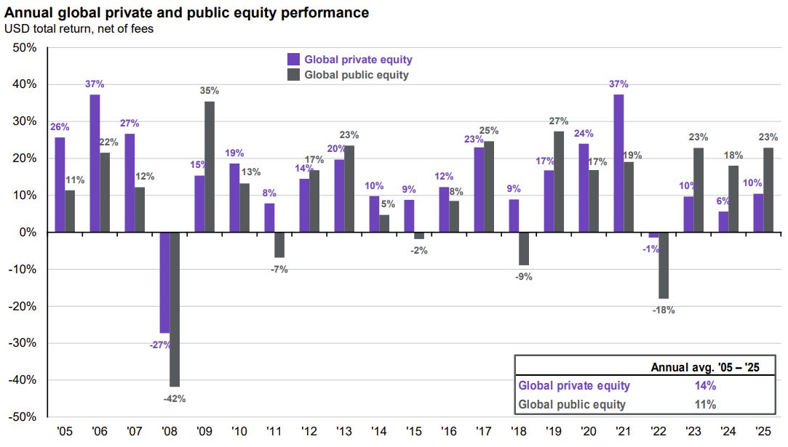
- The above chart shows global private equity net returns relative to global public markets on an annual basis since 2005.
- Although returns in private equity have lagged those achieved in public equity over the past three years looking at a longer historical perspective shows that private equity has added an illiquidity premium to returns over the long run.
- For long-term portfolios that don’t require complete liquidity an allocation to private equity can be beneficial from both a diversification and return standpoint.
Source: offthecharts.substack.com/p/a-closer-look-at-private-equity
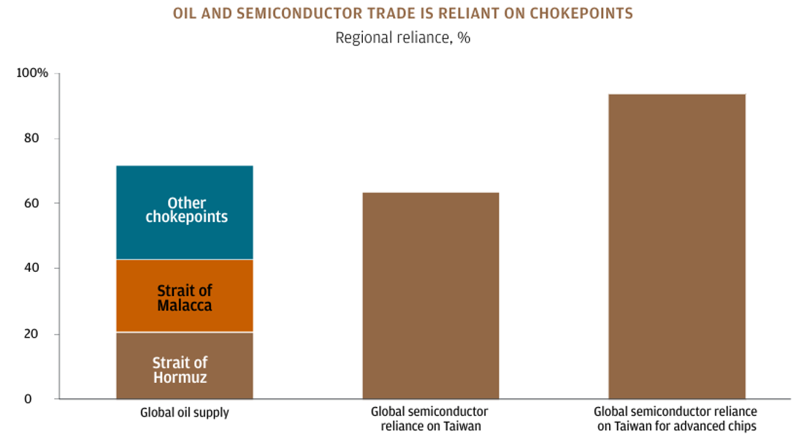
- The above chart shows that a few chokepoints carry a heavy share of essential trade for the global economy in energy and chips.
- The chart highlights Taiwan’s unique place in the global chip market as TSMC manufactures more than 90% of the world’s advanced semiconductors.
- Disruption of trade through the Taiwan straight could cause a severe shock in the global technology market with economists estimating potential drag on global GDP of up to -5% in this scenario.

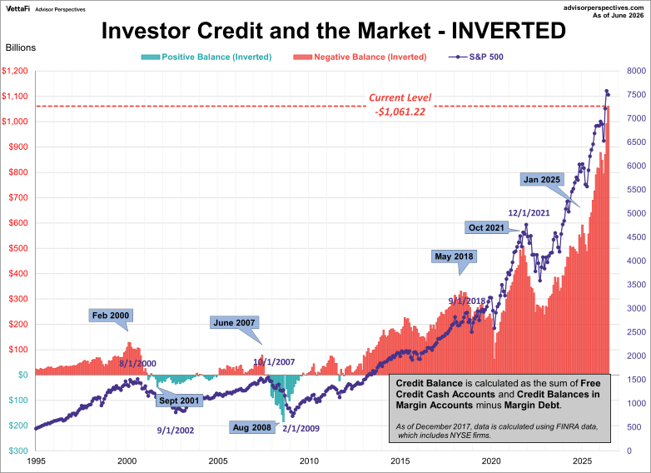
- The above chart shows investor credit balances minus margin debt overlayed with S&P 500 performance.
- Investors historically have negative credit balances as the market makes new highs, taking on leverage to boost returns.
- The chart shows that these debt levels peak prior to major market crashes when widespread selling of securities, including forced sales through margin calls, cause margin balances to turn positive.
Download a copy of this article in pdf here.
Insights
View AllNews & Events

News & Events
Keep up to date on Our Family Office's latest firm news, events, global and regional awards, as well as the latest announcements.
Tim Cestnick’s Globe & Mail Articles
Tim Cestnick's Globe & Mail Articles
Catch up on our Co-Founder and CEO, Tim Cestnick's weekly column. His status as an expert is reinforced by his role as a tax and personal finance columnist for The Globe and Mail, Canada’s most prominent national newspaper.
Investment Thinking

Investment Management
We provide tax-efficient preservation and growth of your investment assets, utilizing best-in-class global strategies, strategic asset allocation, rigorous due diligence on managers and their selection.
Podcasts

Podcasts
Our Family Office proudly presents the Our Family Office Podcast. Throughout the inaugural season, host Adam Fisch speaks to various experts from across our firm, offering insights into the areas of focus for an integrated family office, and the ways that a Shared Family Office™ can help Canada’s wealthiest families.